
What a screaming waiter in Hong Kong taught me about authenticity — January. Hong Kong, a street bar in Central. One I’d visited a few times before.
I’m trying to get the attention of one of the waitresses — but at that moment her coworker starts screaming at me in Chinese. So loudly. If you’ve never heard Chinese spoken at full volume, it’s powerful. It pulls the attention of everyone eating there during the busy lunch hour. Even the waitress I was trying to reach looks a little scared.
I didn’t understand a word he was saying — but I sat down in the spot he pointed to and waited to see what would happen.
That man is now one of the people I love visiting for lunch. He welcomes me with a smile and asks: “The same?”
He’s a simple man. That particular day was busy — and he reacted honestly to what he was feeling in that moment. I didn’t understand his Chinese words — sit down and wait — and he exploded.
But you know what I appreciate about that?
He was real. He wasn’t performing. Wasn’t pretending. He just reacted to the conditions in front of him.
He works hard. He’s not trying to be a star. Just doing his part and trying to manage the street chaos and the constant flow of people coming to eat.
The next time I came — he welcomed me with a smile that said, quietly: it’s okay.
I’m not saying it’s good to lose your temper. But I value honesty. Not trying to look a certain way. Not trying to always be liked.
The Coffee Shop in Shanghai
A woman working in a small, cozy coffee shop in Shanghai.
I went in and asked for a large hot latte with oat milk. She was busy at that moment — and told me she didn’t have oat milk, only coconut. She could give me a taste first, and if I didn’t like it, no worries — she’d help me find another coffee shop nearby.
I don’t like coconut milk in coffee. But something about this woman made me stay and try.
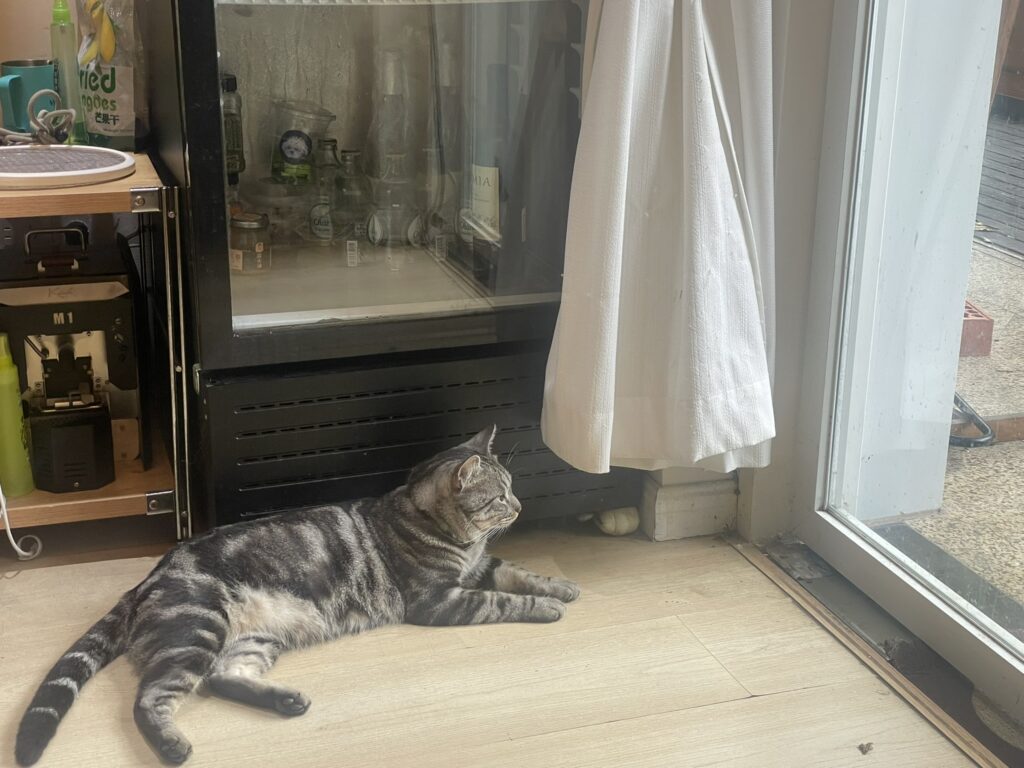
The place — honestly — was a little dirty. Full of cat photos. Cat food in the fridge at the same level as the drinks for sale. Boxes of cables and cat toys everywhere.
One thing caught my eye: there was nothing there to show off. Nothing designed to make an impression.
No need to charm me. No need to be admired by me.
It was like someone simply saying: “You like me, you like the place — you can stay. Your choice. I’m the same either way. I’m not adjusting. This is what I have. You can join.”
And honestly? Not for a single moment did I find myself thinking about what she wanted from me. Whether she was expecting a tip. No playing. No performance.
The coconut milk turned out to be good. And I took the coffee — but mostly because of the simplicity of this woman and this place.
She wasn’t trying to be nice. She wasn’t paying attention to the money I paid — she quietly made me a larger size even though she only had one size on offer, without pointing it out or waiting for my gratitude. She just did what she could to give me what I was looking for — and then turned her attention back to the other guests.
I felt genuinely comfortable there. Normal. A home vibe. Nothing to pretend. No performance for anyone watching.
Her cat was the most important guest — sitting in everyone’s way and making people trip over him as they walked through.

This isn’t in contradiction with the fact that the most interesting and powerful people I’ve met travel widely and build across many areas of their lives.
I’m not saying that simplicity of life, money, or lifestyle defines us. Not at all.
It’s about calculating and playing.
After meeting so many people from so many backgrounds — so many business-minded people, people who play the game, who choose the right mask when it’s needed, who are always working to be noticed and admired — I’ve started to value simplicity even more. Simplicity in motives. In behavior. People who are just themselves and don’t try to charm you at every step.
Here’s the uncomfortable part.
We say we want people to be nice to us. We don’t. What we actually want is to stop being managed. To spend five minutes with someone who isn’t quietly running a pitch — reading our reaction, adjusting the mask, waiting for the applause.
The screaming waiter wasn’t nice. The coconut-milk woman literally offered to send me somewhere else. Neither of them needed a single thing from me — not my approval, not my tip, not my return visit. And that’s exactly why I keep going back.
Because people who are always performing for you are telling you something, whether they mean to or not: your opinion of me runs the show. And when your opinion runs the show, you can never fully relax around them. You’ve been quietly drafted as their audience. A job you didn’t apply for.
The rare ones — the waiter, the woman, the cat sitting in everyone’s way like he owns the place — have opted out of that game entirely. They’re not trying to be liked. Which happens to be the only condition under which being liked means anything at all.
But it’s easy to point at other people’s performances. The harder question points the other way. So here’s the one worth sitting with: who in your life are you performing for — and what would actually happen if you just stopped?
Because authenticity was never about finding your “true self,” whatever that’s supposed to be. It’s simpler and harder than that. It’s just not needing the room to clap.