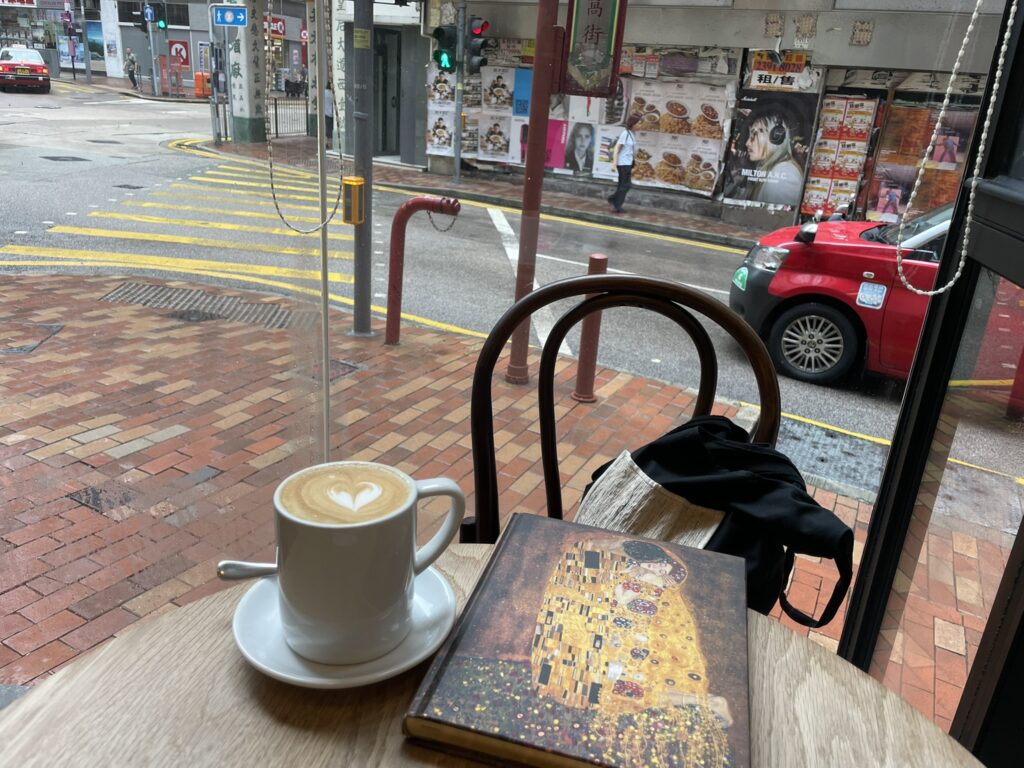
The hidden cost of always wanting more — I’m at Café Detour, Hong Kong Island. I came here in the morning, cutting through the whole rush of the city, to read something that would strengthen me — something tied to my values. But this glass-walled space, tucked into the corner of a busy street, gives off this kind of inspiration and room to think. Ideas just start arriving on their own — about life, about solutions, about business.
All it takes is a few seconds on AI and suddenly there are new technical possibilities. I glance at what’s improving, see what’s possible now and how fast — and the previous ideas multiply by ten in my head. A total brainstorm.
I know I had a different plan for this morning. But I’ve learned to use a moment of inspiration fully when it shows up — because it’s not something that arrives on command, scheduled into a calendar slot.
In every area and space I’m involved in (and that’s not a small number), I see an option to upgrade, to improve, to scale, possibilities for right now, something I could build in two months.
But I also see at least a few other realistic paths I could start walking, build, and develop.
I love this moment. The excitement, the experience from different areas, the realism, the technical knowledge, the current possibilities technology gives us — it all piles up into a kind of mess. Something that looks chaotic but starts forming new connections, new spaces.
I love it. But I know it’s also a trap if you don’t draw a line somewhere.
In a moment like this I write down a few of the better ideas — but I also remind myself where my world currently stands.
A few areas with real potential, which give me freedom right now, which I keep developing — but don’t have to. I have the desire, so I do it, I grow it, I expand it. But they’re built and designed in a way that lets me sit here drinking coffee right now and not have to do anything.
I could develop work with companies, contracts, projects. I could open a business abroad — a friend who’s genuinely excellent in business once offered me a partnership and support on exactly that. That’s appealing. But it would take away the lightness from the backbone that’s currently giving me so much value.
Then I’d have to.
Right now I’m drinking this coffee, just enjoying the sight of small Chinese kids in rain gear, dressed up as dinosaurs, jumping in the rain — which gets remarkably intense in Hong Kong this time of year.
Right now I have the space to actually enjoy that. And the biggest dilemma of the moment is whether to go for breakfast now, or wait and see if the downpour eases up or gets worse.
A lot is possible. Every one of us — whether we realize it or not — has an enormous amount of resources.
But before you start building something — think carefully about what you’ll pay for it.
What are your values? What actually gives you satisfaction in life? Will the achievement, the money you’ll gain — will it actually be worth your time, your attention, your freedom?
Maybe yes. Everyone enjoys something different. For a long time, walking into business meetings with a briefcase, representing a company — that gave me genuine pleasure. I still enjoy it. I’ve just chosen travel for now.
But before you choose — think about what kind of life you actually want to live.
Is an idea good just because most people, given the same opportunity, wouldn’t hesitate for a second?
If you do and think the way “everyone” does — you’ll end up where everyone ends up. Which is — where, exactly?
Often: in tension. In a lack of meaning. In compensating for self-worth through outward display — clothes, status. In never having a moment to notice how much you already have. In not knowing how to say no when a money-making opportunity shows up. In trading your values for something tangible the moment the chance appears.
I’m not saying everyone. I’m not even saying that kind of life is wrong.

But I see an enormous amount of this pattern among people I know — chasing a happiness that keeps slipping out of their hands.
So before you get pulled into the spiral — think about where you actually want to end up. Choose consciously.
The brainstorm felt electric. The ideas were real. The opportunities — probably genuine.
And I chose the coffee and the dinosaurs in the rain.
Not because I couldn’t. Because I could — and didn’t have to.
That’s the difference.